
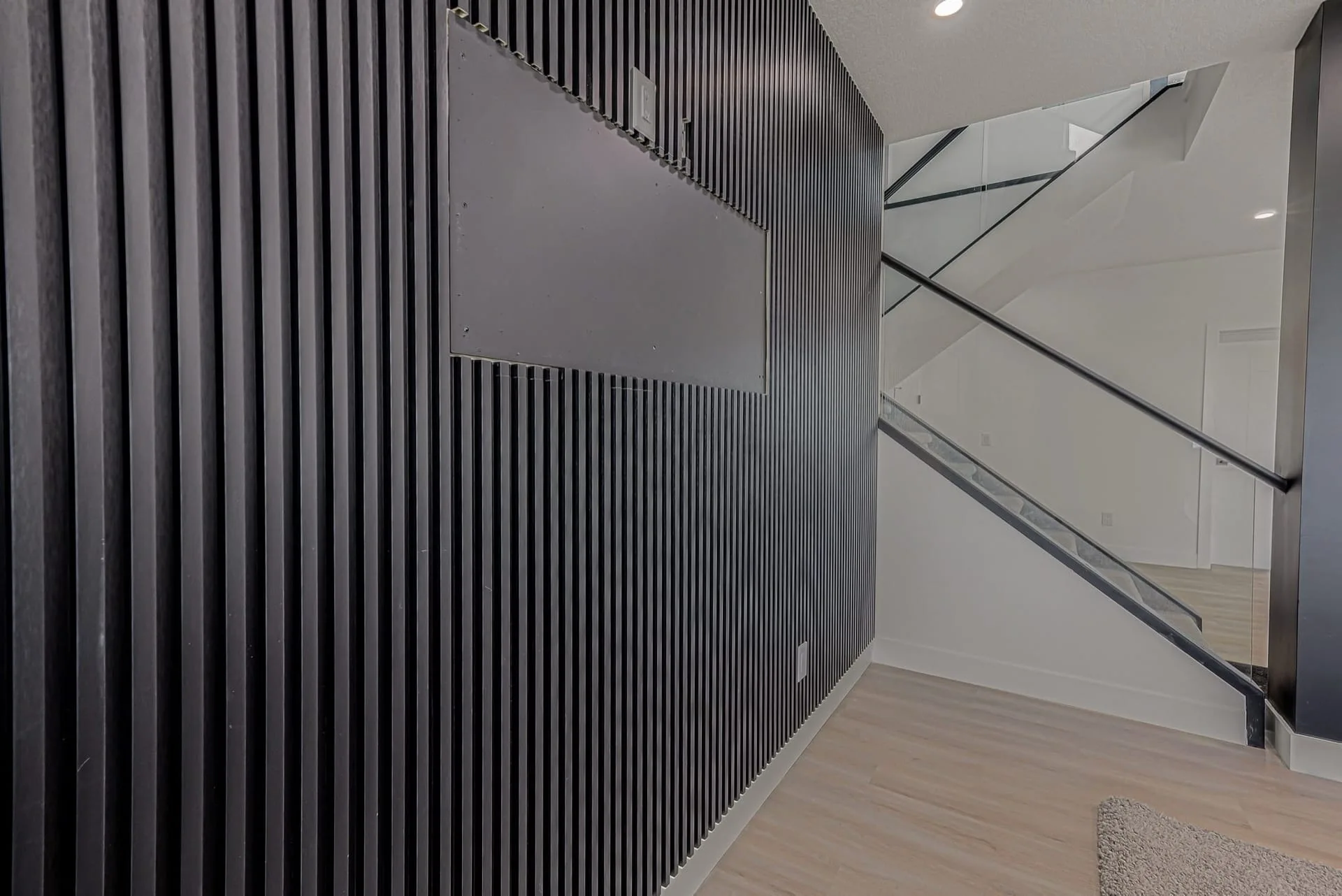
Both a legal suite and a lifestyle basement can add value to your Calgary home, but they’re fundamentally different projects with different costs, uses, and operating responsibilities. This comparison uses illustrative planning ranges, not promises of rent, ROI, appraisal value, or payback. Confirm the address-specific permit path, current market comparables, financing, insurance, and tax treatment before deciding.
Legal Suite vs. Lifestyle Basement: Head-to-Head
| Factor | Legal Suite | Lifestyle Basement |
|---|---|---|
| Primary Use | Rental income + housing | Family recreation + value |
| Separate entrance | Required | Not required |
| Kitchen | Full kitchen required | Optional (wet bar only) |
| Fire separation | 1-hour rated assembly | Standard code |
| Egress windows | Enhanced (rescue opening) | Standard per code |
| Separate HVAC | Independent heating required | Shared system OK |
| Development permit | Required | Not required |
| Permits required | 2 (dev + building) | 1 (building only) |
| Typical Total Cost | $60K-$120K | $40K-$70K |
| SSIP Rebate | Up to $10K if the City confirms eligibility | $0 |
| Property value impact | Property- and appraisal-dependent | Property- and appraisal-dependent |
| Annual rental income | Scenario-dependent | $0 unless use changes |
| Timeline | 4 to 8 months | 3 to 5 months |
Cost Analysis: Where the Money Goes
| Cost Component | Legal Suite | Lifestyle Basement |
|---|---|---|
| Permits & approvals | $1,800 | $500 to $800 |
| Design & drawings | $2,500 | $1,500 to $2,000 |
| Demolition & prep | $3,500 | $2,000 to $3,000 |
| Framing & structure | $11,000 | $7,000 to $9,000 |
| Electrical | $9,000 | $5,000 to $7,000 |
| Plumbing | $13,000 | $3,000 to $5,000 |
| HVAC | $6,000 | $3,000 to $4,000 |
| Egress & windows | $4,500 | $2,000 to $3,000 |
| Separate entrance | $8,000 | $0 |
| Kitchen | $13,000 | $0 (wet bar $3K-$5K) |
| Bathroom | $8,000 | $4,000 to $6,000 |
| Flooring, drywall, paint | $11,000 | $8,000 to $10,000 |
| Total | $90,300 | $38,000 to $53,000 |
Key insight: A legal suite often costs more because of the kitchen, separate entrance, independent systems, and permit complexity. Whether rental income offsets that premium depends on the property’s actual rent, vacancy, operating costs, financing, and tax treatment.
ROI Comparison: The Numbers That Matter
Scenario A: Legal Suite ROI
This is an illustrative scenario using a $1,400 monthly rent assumption and an $85,000 project cost. Replace the assumptions with current comparable listings and property-specific costs.
| Item | Annual |
|---|---|
| Gross rental income ($1,400/mo) | $16,800 |
| Less: Vacancy (5%) | -$840 |
| Less: Maintenance & repairs | -$840 |
| Less: Insurance increase | -$600 |
| Less: Utilities (if included) | -$1,800 |
| Net annual income | $12,720 |
| Simple operating return (on $85K cost) | 15% in this scenario |
| Simple payback (not a forecast) | 6.7 years in this scenario |
Scenario B: Lifestyle Basement ROI
| Item | Analysis |
|---|---|
| Direct annual income | $0 (non-income property) |
| Property value impact | Appraisal- and market-dependent |
| Payback period | Not applicable to a non-income use |
| ROI (at resale) | Depends on sale price, costs, and timing |
| Intangible value | Family enjoyment, entertainment space |
The comparison: A legal suite can generate cash flow while it is rented, but it also adds landlord, compliance, maintenance, and vacancy responsibilities. A lifestyle basement is generally a non-income renovation whose value is realized through use and any future sale; neither outcome is guaranteed.
Which Should You Build? Decision Matrix
Choose a Legal Suite If:
- You want monthly cash flow to cover mortgage, property taxes, or retirement income
- You can handle being a landlord (tenant management, maintenance, regulations)
- Your neighborhood has strong rental demand (check recent rents for suites in your area)
- You’re comfortable with the complexity of permits, inspections, and code compliance
- Your property-specific model still works under conservative rent, vacancy, cost, financing, and tax assumptions
- You want a documented suite for rental or family use and accept the operating responsibilities
- The City confirms any SSIP eligibility in writing before you count it in the budget
Choose a Lifestyle Basement If:
- You want a space for your own family (home theatre, gym, guest room, playroom)
- You don’t want the complications of being a landlord
- You want immediate enjoyment rather than an income model
- Your rental market is soft (low vacancy, low rents)
- You prefer a simpler, faster renovation (fewer permits, faster completion)
- You may sell in 3 to 5 years and prefer not to underwrite rental occupancy
- You want lower upfront cost and simpler financing
The Hybrid Approach
Some Calgary homeowners build a basement with rental potential: finished space that could be rented out, but isn’t right now. No separate entrance, no full kitchen, so it’s not a legal suite. But it’s designed to be rentable without requiring additional work later. Cost is between basement and suite. It’s the “optionality” play.
FAQ: Legal Suite vs. Basement
Can I convert my lifestyle basement to a legal suite later?
Partially. Adding a separate entrance and full kitchen + HVAC systems would require new permits and significant work. Better to decide upfront. If you’re unsure, design with rental potential in mind (no shared features, good soundproofing).
Which adds more to property value?
There is no universal dollar range. A permitted suite or finished basement may contribute value differently depending on comparable sales, documentation, quality, market demand, and the appraiser’s methodology. Ask for a current appraisal or lender opinion instead of underwriting a fixed increase.
What if my legal suite sits empty?
Vacancies happen in every market. Use a conservative, property-specific vacancy assumption and test what happens if the suite is empty for several months; there is no reliable city-wide percentage for every property.
Is a legal suite worth the extra $40,000?
It depends on the address-specific model. Test current comparable rent, vacancy, operating costs, financing, taxes, and the incremental cost of the suite against the simpler basement option. If the model only works at optimistic assumptions, the lifestyle basement may be the lower-risk choice.
What about taxes on legal suite income?
Rental income is taxable. You can deduct mortgage interest, insurance, maintenance, utilities (if you pay them), property taxes, and depreciation (CCA). Consult an accountant. Tax planning can significantly impact your bottom line. The lifestyle basement has zero rental tax complexity.
📨
Stay Ahead of the Curve
Join Calgary homeowners getting insider renovation tips, market updates, and exclusive cost data. Weekly. No fluff.
Get Weekly Insights
Welcome aboard! Check your inbox for a confirmation email.
Unsubscribe anytime. We respect your inbox.
Get Your Free Guide
Enter your details below and we’ll send the complete guide straight to your inbox.
What are you planning? (optional) Legal Suite Development Basement Development Garage Development Commercial Project Not Sure Yet
Send Me the Guide Sending…
We respect your privacy. Unsubscribe anytime. No spam, ever.
✓
Check Your Inbox!
Your guide is on its way. While you wait, explore more resources below.